
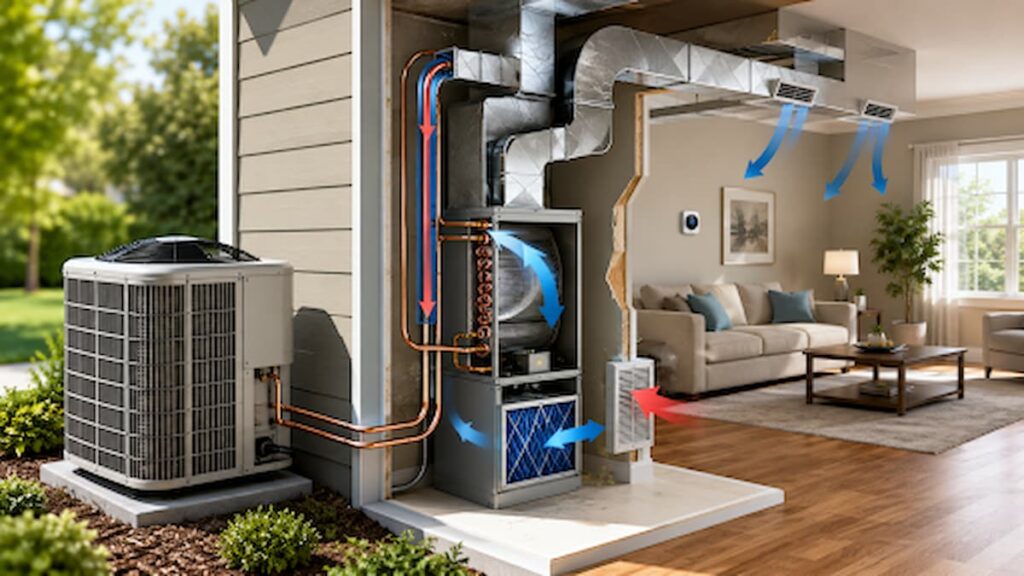

Air conditioning can feel like a simple process: set the thermostat, wait for the room to cool, and enjoy the result. Behind that comfortable indoor temperature, however, is a carefully coordinated system that removes heat from your home and releases it outdoors.
Understanding how an air conditioning system works can help homeowners spot problems earlier, use their equipment more effectively, and know which maintenance tasks are safe to handle themselves.
Whether you have central air conditioning, a heat pump, or a ductless mini-split, the basic principle is similar. The system moves heat rather than simply “creating cold.”
How Does Air Conditioning Work?
An air conditioner removes heat from indoor air and transfers it outside.
A typical cooling cycle works roughly like this:
- The thermostat detects that the indoor temperature is above the selected setting.
- The indoor blower moves warm air across the evaporator coil.
- Refrigerant inside the coil absorbs heat from the air.
- The cooled air is returned to the living space.
- The refrigerant carries the absorbed heat to the outdoor unit.
- The compressor and condenser coil help release that heat outdoors.
- The refrigerant returns indoors, and the cycle repeats.
At the same time, moisture can condense from the indoor air as it passes over the cold evaporator coil. This helps reduce indoor humidity as well as temperature.
The Main Components of an Air Conditioning System
Each major component has a specific role. If one begins to malfunction, the effects can spread throughout the system.
Thermostat
The thermostat acts as the control point for the cooling system.
When the indoor temperature rises above the selected setting, the thermostat signals the air conditioner to begin a cooling cycle. Once the desired temperature is reached, it tells the system to stop or reduce operation, depending on the equipment and controls.
Modern programmable and smart thermostats can also help manage schedules and temperature settings more efficiently.
Evaporator Coil
The evaporator coil is usually located inside the home or within the indoor air-handling equipment.
Cold refrigerant flows through the coil. Warm indoor air passes over it, allowing heat to transfer from the air into the refrigerant.
If the evaporator coil becomes dirty or airflow is restricted, cooling performance can suffer.
A frozen coil is another warning sign. Several problems can contribute to coil icing, including restricted airflow and refrigerant-related issues.
Compressor
The compressor is located in the outdoor unit.
Its job is to compress refrigerant and help move it through the refrigeration cycle. This component works under significant pressure and requires specialised equipment and knowledge to service.
A compressor problem can result in poor cooling, unusual noises, repeated system shutdowns, or a system that does not operate correctly.
Compressor repairs are not a suitable DIY task for homeowners.
Condenser Coil
The condenser coil is part of the outdoor unit.
After the refrigerant absorbs heat indoors, it carries that heat outside. The condenser coil allows the heat to be released into the outdoor air.
Leaves, grass, dirt, and other debris around the outdoor unit can interfere with airflow and heat transfer. Keeping the area around the equipment clear is therefore an important homeowner maintenance task.
Blower Fan
The indoor blower moves air through the system.
It pulls air from the home, pushes it across the evaporator coil, and sends the conditioned air through the ductwork and into the rooms.
Weak airflow can be caused by several issues, including a clogged filter, blocked ductwork, blower problems, or other system faults.
Air Filter
The filter captures airborne particles before air reaches the indoor equipment.
A heavily clogged filter can restrict airflow. The system may then have to work harder to move air, and comfort can suffer.
How often a filter needs changing depends on the filter type, household conditions, pets, occupancy, and equipment requirements. Rather than relying on one universal schedule, check the filter regularly and follow the manufacturer’s recommendations.
Refrigerant
Refrigerant is the substance that transfers heat through the cooling system.
It changes between liquid and vapour states as it moves through different parts of the refrigeration cycle. These changes allow the refrigerant to absorb heat indoors and release it outdoors.
Refrigerant is not something homeowners should add or handle themselves. If a system has a low refrigerant charge, the underlying cause needs to be investigated by a qualified HVAC professional.
Condensate Drain
As an air conditioner removes moisture from indoor air, water forms on the evaporator coil. That water needs somewhere to go.
The condensate drain system carries the water away from the indoor equipment.
A blocked drain can cause water to back up, potentially leading to leaks or water damage. Homeowners should take unexplained water around indoor HVAC equipment seriously.
Understanding the Refrigeration Cycle
The refrigeration cycle is the heart of conventional air conditioning.
The process involves four basic stages.
1. Evaporation
Refrigerant absorbs heat from indoor air as it passes through the evaporator coil.
2. Compression
The compressor raises the refrigerant’s pressure and temperature before it moves toward the outdoor coil.
3. Condensation
The hot refrigerant releases heat outdoors through the condenser coil and changes state.
4. Expansion
The refrigerant passes through an expansion device, reducing its pressure and preparing it to absorb heat again.
The cycle then repeats.
You do not need to understand every technical detail to appreciate the basic principle: heat is collected indoors, carried by refrigerant, and released outside.
How Airflow Affects Cooling Performance
An air conditioner needs more than a working refrigeration circuit to cool a home effectively. Airflow is equally important.
The general path is:
Return air → filter → indoor coil → blower → supply ducts → rooms
If airflow is restricted anywhere along this path, the system may struggle to deliver conditioned air.
Poor airflow can contribute to:
- Uneven temperatures
- Reduced comfort
- Longer cooling cycles
- Higher energy use
- Frozen evaporator coils
- Increased equipment strain
This is why changing a dirty filter is more than a housekeeping task. It can help protect proper airflow.
What Is Cooling Capacity?
Cooling capacity describes how much heat an air conditioning system can remove over a given period.
In the United States, cooling equipment is commonly rated in BTUs per hour. A system’s capacity needs to be appropriate for the home and its conditions.
Bigger is not automatically better.
An oversized system can cool a space quickly but may not run long enough to remove sufficient humidity. An undersized system may struggle to reach the desired temperature during periods of high outdoor heat.
Proper equipment sizing should consider factors such as the home’s size, insulation, windows, climate, orientation, and heat gains.
What Is Temperature Differential?
Temperature differential refers to the difference between two temperatures, often the temperature of air entering and leaving the indoor cooling equipment.
Technicians may use temperature measurements as part of a broader diagnostic process.
However, a single temperature difference does not provide a complete picture of system health. Outdoor conditions, humidity, airflow, equipment design, and operating conditions all matter.
Homeowners should avoid diagnosing an air conditioner based on one measurement alone.
How Air Conditioners Remove Humidity
Cooling and dehumidification happen together in many conventional air conditioning systems.
Warm, humid indoor air passes over the cold evaporator coil. As the air cools, some of its moisture condenses on the coil and drains away.
This is one reason a properly operating air conditioner can make a room feel more comfortable even when the thermostat setting has not changed dramatically.
An oversized system, however, may complete cooling cycles too quickly to provide as much moisture removal as the home requires.
How Heat Pumps Cool a Home
A heat pump can provide both heating and cooling by reversing the direction of heat movement.
In cooling mode, a heat pump operates similarly to an air conditioner. It removes heat from indoors and releases it outside.
In heating mode, the system reverses the refrigeration cycle and moves heat from outdoors into the home.
This makes a heat pump capable of providing year-round temperature control with one system.
How Ductless Mini-Splits Work
Ductless mini-split systems use the same fundamental heat-transfer principle but do not require traditional ductwork to distribute conditioned air.
A typical system has:
- An outdoor unit
- One or more indoor air-handling units
- Refrigerant lines connecting the components
- Electrical connections
- Individual controls
Because each indoor unit can serve a specific zone, mini-splits can provide flexible temperature control.
They can also be useful in homes without existing ductwork, room additions, garages, converted spaces, or areas where extending ducts would be difficult.
Common Problems and What They May Mean
Different symptoms can provide clues that an air conditioning system needs attention.
Weak Airflow
Possible causes include a clogged filter, blocked ducts, blower problems, or other restrictions.
Start by checking the filter and supply vents. If airflow remains weak, professional diagnosis may be necessary.
Warm Air From the Vents
Warm supply air can result from airflow problems, thermostat issues, refrigerant problems, compressor faults, or other system failures.
If basic checks do not resolve the issue, contact a qualified HVAC professional.
Frequent Cycling
Short or frequent cooling cycles can have several causes, including equipment sizing, thermostat problems, airflow restrictions, or mechanical faults.
Repeated cycling should not simply be ignored because it can affect comfort and equipment operation.
Ice on the Indoor Coil
Ice is not a normal sign of effective cooling.
Restricted airflow and refrigerant-related problems are among the possible causes. Turn off cooling and seek professional advice rather than attempting to remove the ice with tools or altering the refrigerant system yourself.
Water Around the Indoor Unit
Water may indicate a blocked condensate drain, drainage problem, frozen coil, or another fault.
Address the issue promptly to reduce the risk of property damage.
Unusual Noises
Buzzing, grinding, rattling, squealing, or other unusual sounds can indicate mechanical or electrical problems.
Do not remove electrical covers or attempt internal repairs unless you are properly qualified.
What Homeowners Can Safely Maintain
There are several useful maintenance tasks homeowners can perform without opening the equipment.
Check the Air Filter
Inspect the filter regularly and replace or clean it according to the manufacturer’s instructions.
Keep Outdoor Equipment Clear
Remove leaves, grass, branches, and other debris from around the outdoor unit. Maintain adequate clearance as recommended by the manufacturer.
Keep Supply and Return Vents Open
Do not unnecessarily block vents with furniture, rugs, or other objects.
Check for Visible Drain Problems
If you notice water around the indoor equipment, investigate the issue rather than continuing to operate the system without understanding the cause.
Keep the Area Around HVAC Equipment Accessible
Technicians need safe access to equipment for inspection and servicing. Avoid storing boxes or household items around indoor and outdoor HVAC units.
What Requires a Qualified HVAC Professional?
Some air conditioning tasks involve electrical hazards, pressurised refrigerant, specialised tools, or complex mechanical components.
Professional service is appropriate for:
- Refrigerant charging or recovery
- Refrigerant leak diagnosis and repair
- Compressor replacement
- Electrical component repairs
- Motor replacement
- Refrigeration circuit repairs
- Internal mechanical repairs
- Major ductwork modifications
- Equipment replacement and sizing
Never attempt to open refrigerant circuits or work on electrical components simply because a system appears straightforward.
How to Keep an Air Conditioner Working Efficiently
Good operation begins with basic maintenance and sensible use.
Keep filters clean, maintain clear airflow, avoid blocking vents, and keep the outdoor unit free from significant debris.
Annual professional maintenance can also help identify developing problems before they become major failures. The exact maintenance requirements vary by system, age, condition, and manufacturer recommendations.
It is also worth paying attention to changes in performance. A gradual increase in energy use, unusual sounds, inconsistent temperatures, or longer cooling cycles may indicate that something has changed.
Frequently Asked Questions
How does an air conditioner cool a house?
An air conditioner removes heat from indoor air using a refrigeration cycle. The heat is transferred into refrigerant, carried to the outdoor unit, and released outside. The cooled air is then circulated back through the home.
Does an air conditioner create cold air?
Not exactly. The system primarily removes heat from indoor air. The resulting cooler air is then distributed throughout the home.
What does the compressor do in an AC system?
The compressor circulates refrigerant through the system and raises its pressure so the refrigeration cycle can transfer heat effectively.
Why is airflow important in air conditioning?
Proper airflow allows the system to move indoor air across the evaporator coil and distribute conditioned air throughout the home. Restricted airflow can reduce comfort and contribute to equipment problems.
Why does my AC remove water from the air?
As humid indoor air passes over the cold evaporator coil, moisture can condense on the coil. The condensate is collected and drained away, helping reduce indoor humidity.
Can homeowners add refrigerant themselves?
No. Refrigerant work should be handled by a qualified HVAC professional with the appropriate equipment and training. Low refrigerant may also indicate a leak or another problem that needs diagnosis.
Why is my air conditioner running but not cooling?
Possible causes include restricted airflow, dirty components, thermostat problems, refrigerant issues, compressor faults, or other mechanical problems. Basic homeowner checks such as the filter and thermostat can be performed first, but persistent problems require professional diagnosis.
How often should an air conditioner be serviced?
The appropriate schedule depends on the equipment, manufacturer recommendations, operating conditions, and system age. Regular professional inspections can help identify developing issues, while homeowners should perform routine filter and airflow checks throughout the year.
Conclusion
An air conditioning system is essentially a heat-transfer system supported by airflow, controls, electrical components, and refrigeration equipment. The evaporator coil absorbs heat indoors, refrigerant carries that heat through the system, and the outdoor condenser releases it.
Understanding these basic principles makes it easier to recognise changes in performance and carry out simple maintenance safely.
Homeowners can help their systems by checking filters, keeping vents open, maintaining clear space around outdoor equipment, and watching for unusual symptoms. Refrigerant, electrical, compressor, and internal mechanical work should be left to qualified HVAC professionals.
A little knowledge can go a long way. When you understand what your air conditioner is designed to do, you are better equipped to maintain it, identify warning signs, and keep your home comfortable.
